
Here is a question that trips up most people evaluating AI agent platforms: what is the difference between giving an agent a tool and giving it a skill?
The short answer is that a tool lets an agent do something. A skill teaches an agent how to think about a problem before doing anything. That distinction sounds academic until you watch an agent with 58 tools burn through 55,000 tokens of context before it processes a single user message. That is a real number from Anthropic's engineering team, and it is the reason the industry moved toward skills.
This article explains what AI agent skills actually are, how they differ from tools and plugins, what happens under the hood when an agent activates a skill, and how to evaluate whether an AI platform's skills architecture is production-ready or just marketing.
What Are AI Agent Skills?
An AI agent skill is a modular capability package: a folder containing instructions, scripts, and reference materials that teaches an agent how to handle a specialized domain. Think of it as a training manual the agent can pick up when needed and set down when finished.
A skill to create financial reports might include instructions on how to structure executive summaries, a script that pulls data from an accounting API, reference material on GAAP formatting standards, and guardrails about what claims require citations. The agent does not carry all of that knowledge at all times. It loads the skill when the task requires it.
Anthropic formalized this concept in late 2025 with their Agent Skills standard. The format is intentionally simple: a folder with a SKILL.md file (markdown instructions with YAML metadata) and optional subdirectories for scripts, references, and assets. Within weeks of release, OpenAI, Google, GitHub, and Cursor adopted the same format. By early 2026, it had become a de facto standard.
The simplicity is the point. A skill is a markdown file, not a database schema or a compiled binary. Anyone who can write clear instructions can create one.
Skills vs Plugins vs Tools: What Is the Difference?
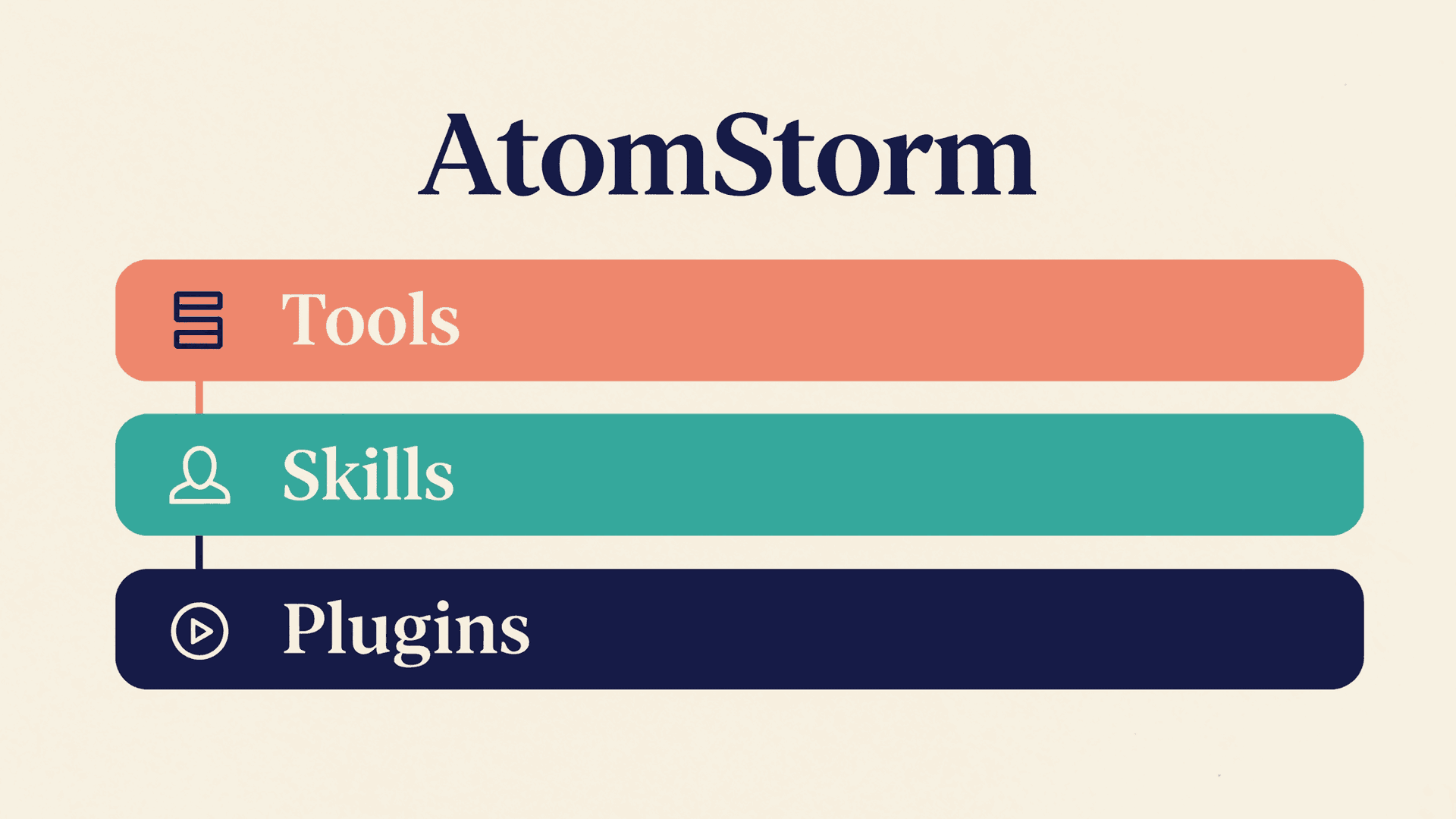
These three terms get mixed up constantly. They operate at different architectural levels and solve different problems.
| Tools | Skills | Plugins | |
|---|---|---|---|
| What it is | An atomic function that executes an action | A knowledge package that shapes how the agent approaches a problem | A distribution bundle that packages skills, tools, and configs for installation |
| Abstraction level | Lowest: single operation | Middle: domain expertise | Highest: installable unit |
| Example | query_database(sql) | A folder that teaches the agent how to diagnose database performance issues | A "Database Ops" plugin containing 3 skills + 5 tools + configuration |
| Token cost | Schema always loaded (can be expensive) | Metadata loaded at startup (~80 tokens), full body loaded on demand | Varies by contents |
| Who creates them | Developers writing function signatures and API integrations | Domain experts writing instructions, developers writing scripts | Platform teams assembling distributable packages |
The critical insight: tools execute, skills prepare. When an agent invokes a tool, something happens in the world. A database gets queried, a file gets written, an API gets called. When an agent activates a skill, its context changes. It gains knowledge, behavioral patterns, and access to referenced resources. Then it decides which tools to use and how.
This is not a subtle distinction. It determines where intelligence lives in your system.
In a tools-heavy architecture, the agent is generic. Intelligence comes from well-designed tool interfaces. The agent's job is selection and orchestration. This is how most LangChain and early OpenAI integrations worked.
In a skills-heavy architecture, intelligence lives in the agent itself. Tools become simpler utilities. The agent carries domain expertise, not just a list of functions it can call. This is the model Anthropic championed, and it is gaining ground because it handles the scaling problems that tools-only architectures hit.
How AI Agent Skills Work Under the Hood
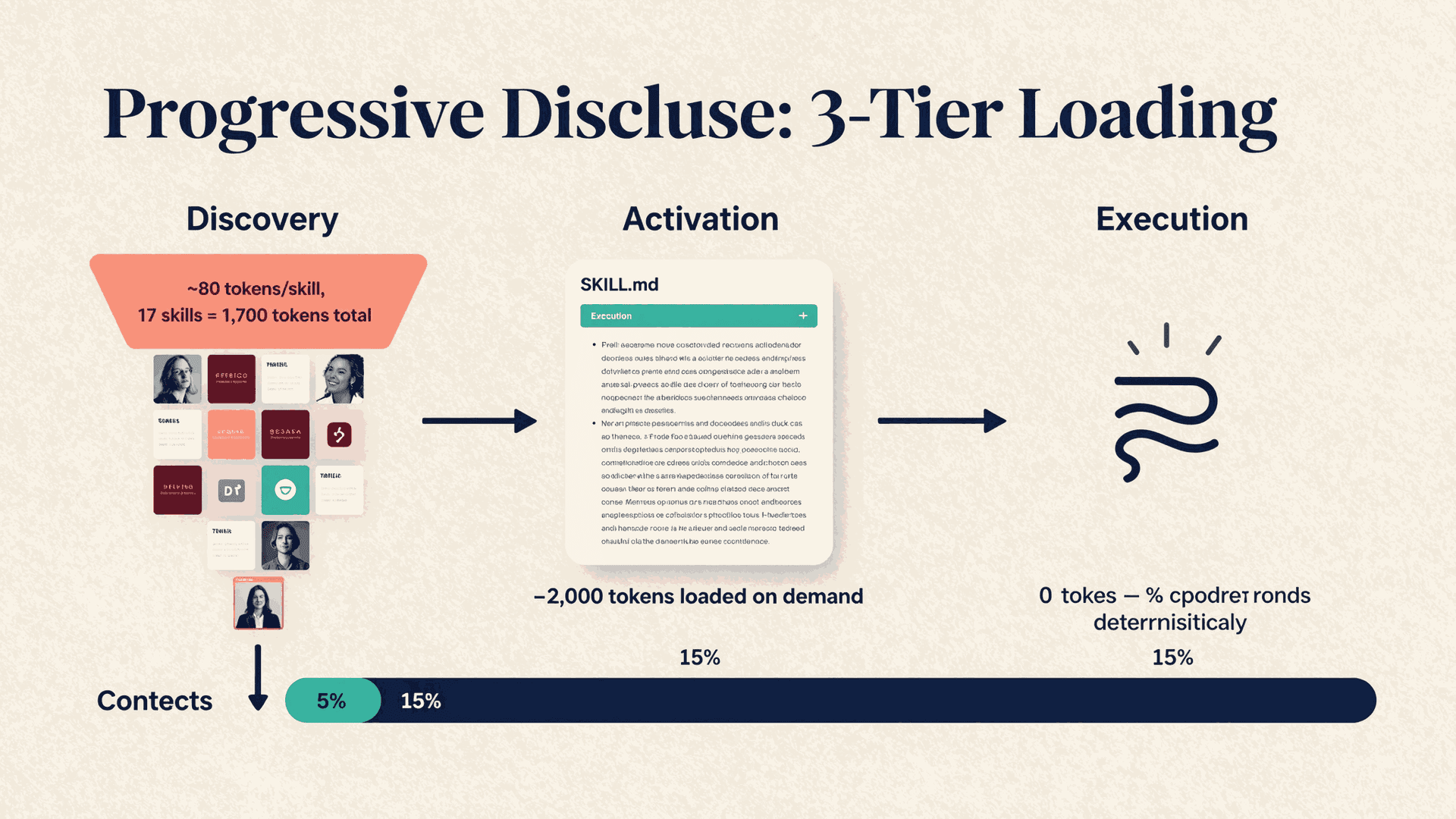
The architecture that makes skills practical is called progressive disclosure. It operates in three tiers, each loading more context only when needed.
Tier 1: Discovery
At startup, the agent loads a one-line summary of every installed skill: just the name and description. The median cost is about 80 tokens per skill. A library of 17 skills costs roughly 1,700 tokens total. This means an agent can be aware of dozens of capabilities without any of them competing for attention in the context window.
Tier 2: Activation
When the agent determines a skill is relevant to the current task, it loads the full SKILL.md body into context. This is the detailed instruction set: step-by-step procedures, decision trees, formatting rules, guardrails. The median body size is around 2,000 tokens, with a recommended ceiling of 5,000.
A financial analysis skill might include instructions like: "When the user provides revenue data, always compute trailing twelve-month growth before presenting projections. If growth rate exceeds 200% year-over-year, flag the number as an outlier and ask for confirmation."
Tier 3: Execution
Complex skills reference additional files: detailed documentation, example templates, scripts. These load only when a specific subtask requires them. And here is the most important part: scripts execute outside the context window. A Python script that transforms a dataset takes zero tokens. It runs, returns a result, and the agent continues with the output.
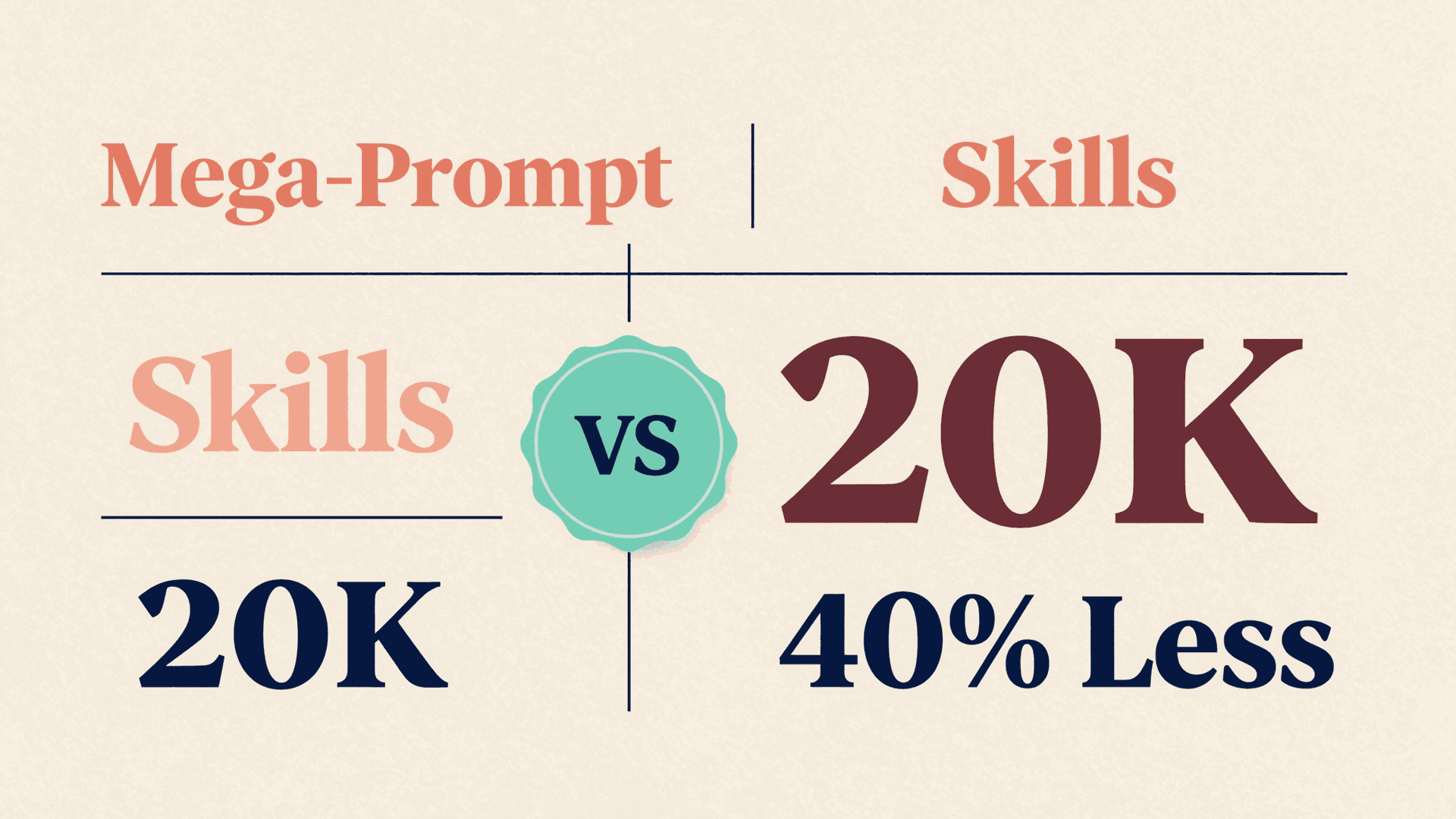
This three-tier architecture reduces average token consumption by roughly 40% compared to loading everything upfront, while improving task completion accuracy by 15-20%, according to empirical measurements from early deployments.
Building an agentic AI workflow that uses skills effectively requires understanding this progressive loading pattern. The architecture determines both cost and quality.
Why Skills Matter More Than Prompts
"Why not just write a really good system prompt?"
This is the most common objection, and it deserves a direct answer. A 20,000-token system prompt that covers financial analysis, document formatting, design principles, and project management sounds comprehensive. In practice, it creates three problems.
Problem 1: Attention dilution. Transformer models divide attention across all tokens in context. A 20K-token prompt means every task competes with 19,000 tokens of irrelevant instructions for the model's attention budget. Research from multiple teams throughout 2025 demonstrated that models perform measurably worse on specific tasks when surrounded by unrelated context. The "lost in the middle" phenomenon is real and well-documented.
Problem 2: No lifecycle management. A mega-prompt is always there. You cannot unload the financial analysis instructions when the user switches to writing a blog post. Skills solve this because they activate and (conceptually) deactivate. The agent loads what it needs, completes the task, and the skill's detailed instructions are no longer consuming active attention.
Problem 3: It does not scale. An organization with 50 use cases needs 50 sections in the mega-prompt. At 500 use cases, the prompt is larger than some models' context windows. Skills scale because each one is independent. Adding a new capability means creating a new folder, not editing a shared document that every other capability depends on.
Manus, an AI agent platform that went viral in early 2026, handles this by constantly rewriting its internal todo list to push the current objective into recent context. Their typical task requires about 50 tool calls. Without active context management, the agent drifts off-task. That is what happens when you rely on static prompts for dynamic workflows.
Anatomy of a Well-Designed Skill
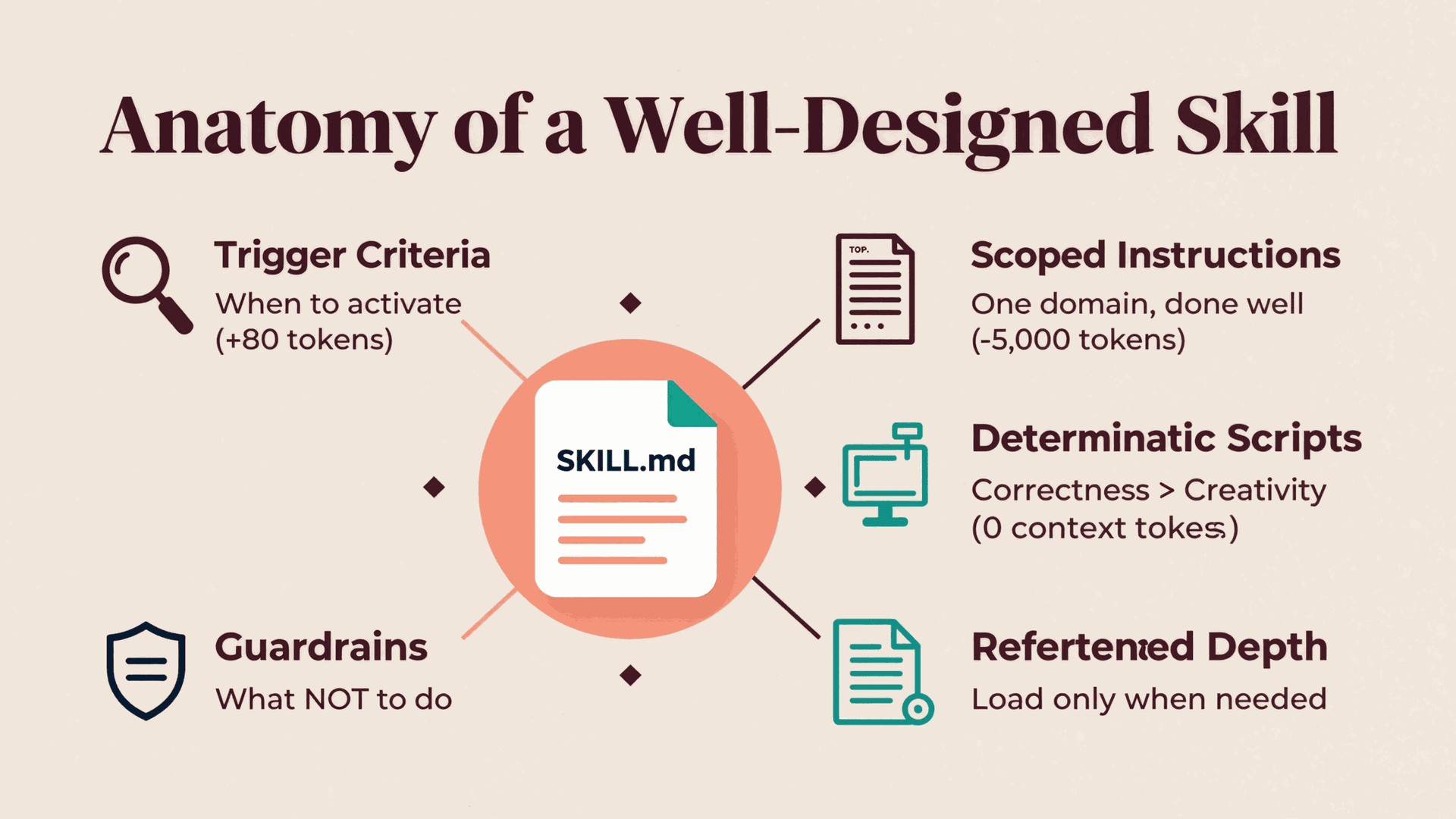
A production skill has five components, whether or not they are all explicit in the file structure.
presentation-design/
  SKILL.md              # Instructions + metadata
  scripts/
    validate_layout.py  # Deterministic checks
  references/
    brand-guidelines.md # Loaded only when brand work is needed
    export-specs.md     # Loaded only when exporting
  assets/
    template.html       # Starter template
1. Clear trigger criteria. The name and description must tell the agent exactly when to activate this skill. "Presentation design" is vague. "Create, edit, or troubleshoot slide decks and visual presentations" is actionable. The agent makes activation decisions based solely on this metadata, so precision matters.
2. Scoped instructions. The SKILL.md body should cover one domain well, not three domains poorly. If a skill needs to reference another skill's territory, it should say "hand off to [other skill]" rather than duplicating instructions.
3. Deterministic scripts. Any operation where correctness matters more than creativity should be a script, not an LLM inference. Validating that a slide layout meets accessibility standards? Script. Sorting a list of financial data? Script. Generating a creative headline? LLM. This division keeps costs down and reliability up.
4. Referenced depth. Detailed reference material lives in separate files, not in the main SKILL.md. A presentation skill's brand guidelines might be 8,000 tokens. Loading them on every activation wastes context. Loading them only when the user says "match our brand" is efficient.
5. Guardrails. What the agent should not do matters as much as what it should do. A financial skill should include: "Never present projected returns without a disclaimer. Never round numbers in a way that changes the conclusion." Guardrails prevent the most expensive kind of failure: confident and wrong output that the user trusts.
Real Examples of AI Agent Skills in Action
Content Creation Skills
AtomStorm uses a multi-agent architecture where each agent activates different skills depending on the task. When a user asks for a pitch deck, the system activates a presentation planning skill (narrative structure, slide sequencing, audience analysis), a visual design skill (layout rules, typography, color harmony), and a quality review skill (consistency checks, brand alignment). Each skill loads independently. The multi-agent collaboration approach means no single agent needs to carry all the expertise.
Research and Analysis Skills
Enterprise deployments use skills for domain-specific research. A due diligence skill might include instructions for scanning SEC filings, templates for risk assessment matrices, and scripts that pull data from financial APIs. The agent does not need these capabilities when writing an email. Progressive disclosure means they appear only when the task matches.
Design and Layout Skills
When vibe design platforms receive a request like "create an architecture diagram for a microservices system," a specialized skill activates that knows how to represent service boundaries, data flows, API connections, and infrastructure layers visually. The skill includes reference material on standard diagramming conventions (C4 model, UML component diagrams) but loads those references only when the user's request implies a specific notation. For more on this workflow, see our explanation of vibe design and how AI handles visual content creation.
How to Evaluate AI Platforms by Their Skills Architecture
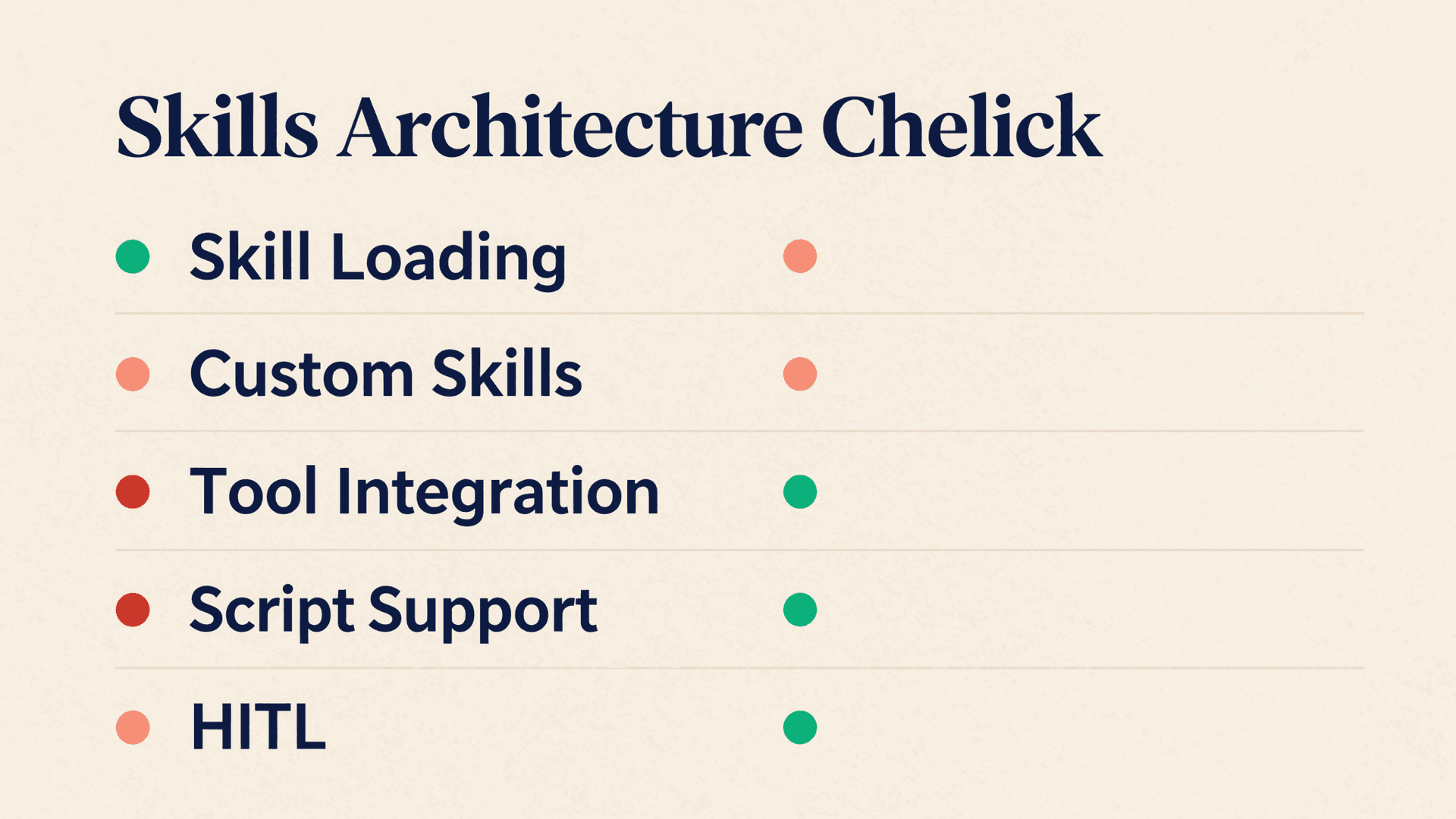
Not every platform that says "skills" means the same thing. Here is what to check.
| What to ask | Strong signal | Weak signal |
|---|---|---|
| How are skills loaded? | Progressive disclosure with on-demand activation | Everything loaded at startup |
| Can users create skills? | Open format (SKILL.md or equivalent) | Vendor-locked, no custom skills |
| How do skills interact with tools? | Skills orchestrate tool usage with domain context | Skills and tools are the same thing (naming only) |
| What happens at scale? | Sub-agent delegation, context lifecycle management | "Just add more skills to the prompt" |
| Are scripts supported? | Yes, with deterministic execution outside context | No, everything is LLM inference |
| Is there HITL? | Skills can define approval checkpoints | Fully autonomous, no user control |
The last point matters more than it might seem. Skills without Human-In-The-Loop checkpoints are autonomous pipelines. Sometimes that is what you want. But for high-stakes tasks, such as financial reporting, legal document generation, or client-facing presentations, the ability to pause and ask for user confirmation is not a feature. It is a requirement.
The Future of Agent Skills: Composability and Marketplaces
The skills landscape is moving toward composability: the ability to stack multiple skills on a single task, with each one contributing its expertise without conflicting with the others.
When AtomStorm generates a pitch deck, the presentation planning skill, visual design skill, and brand consistency skill all contribute to the same artifact. They do not step on each other because each operates on a different dimension of the output. This is composability in practice, and it requires careful design of skill boundaries.
The emerging marketplace model, where third-party developers publish skills that any platform can consume, mirrors what happened with browser extensions, VS Code plugins, and smartphone apps. The SKILL.md format's simplicity (it is just markdown) lowers the barrier to creation. A domain expert who knows nothing about programming can write a skill that makes AI agents better at their specialty.
There is a genuine open question about quality control. A marketplace with 1,000 skills will include some that are excellent and some that are contradictory or poorly written. The agent needs to handle conflicting instructions gracefully. This is an unsolved problem, and anyone who tells you otherwise is selling something.
Getting Started with Skills-Based AI Workflows
If you are evaluating AI agent platforms, look beyond the feature list and ask how the platform manages context.
Start with one high-value skill. Pick a repeatable task that your team does weekly: a report template, a design review checklist, a customer onboarding sequence. Write the instructions as if you were training a new team member. That is your first skill.
Test progressive loading. Does the platform load your skill only when needed? Or does it dump everything into context at startup? The answer determines whether the system will scale or hit a wall at 20 skills.
Measure quality, not just speed. A well-designed skill should improve the accuracy of agent output on its specific domain task. If adding a skill does not change the quality of output, the agent is not using it effectively.
The organizations getting the most value from AI agents in 2026 are not the ones with the most tools. They are the ones with the best-curated skills: modular expertise that loads on demand, executes with precision, and unloads when finished. That is the architecture that scales.
See skills-based AI in action: try AtomStorm's multi-agent workflow and watch specialized agents collaborate on your content. Free to start.