
Most multi-agent demos look impressive for about five minutes. Then the same problem shows up: agents overlap, repeat work, hallucinate responsibilities, and spend more time talking to each other than producing useful output.
That is not a model problem. It is an architecture problem.
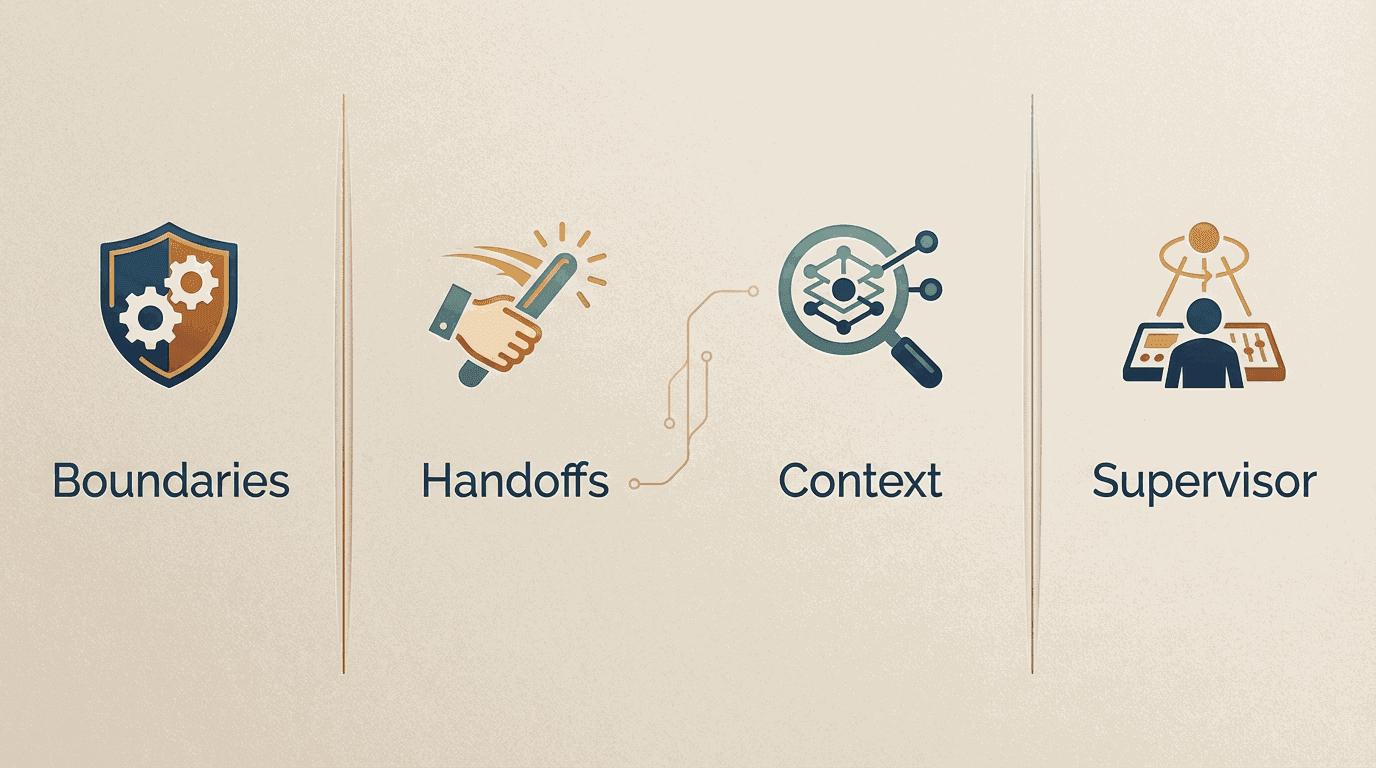
If you want a multi-agent system to survive contact with real users, you need to define the system around boundaries instead of personalities. An agent is not valuable because it has a clever prompt. It is valuable because it owns one narrow job and produces an output that the rest of the pipeline can trust.
Start with specialized roles, not a swarm
The easiest way to wreck a multi-agent system is to give every agent broad authority. Once that happens, you no longer have composition. You have duplicated generalists.
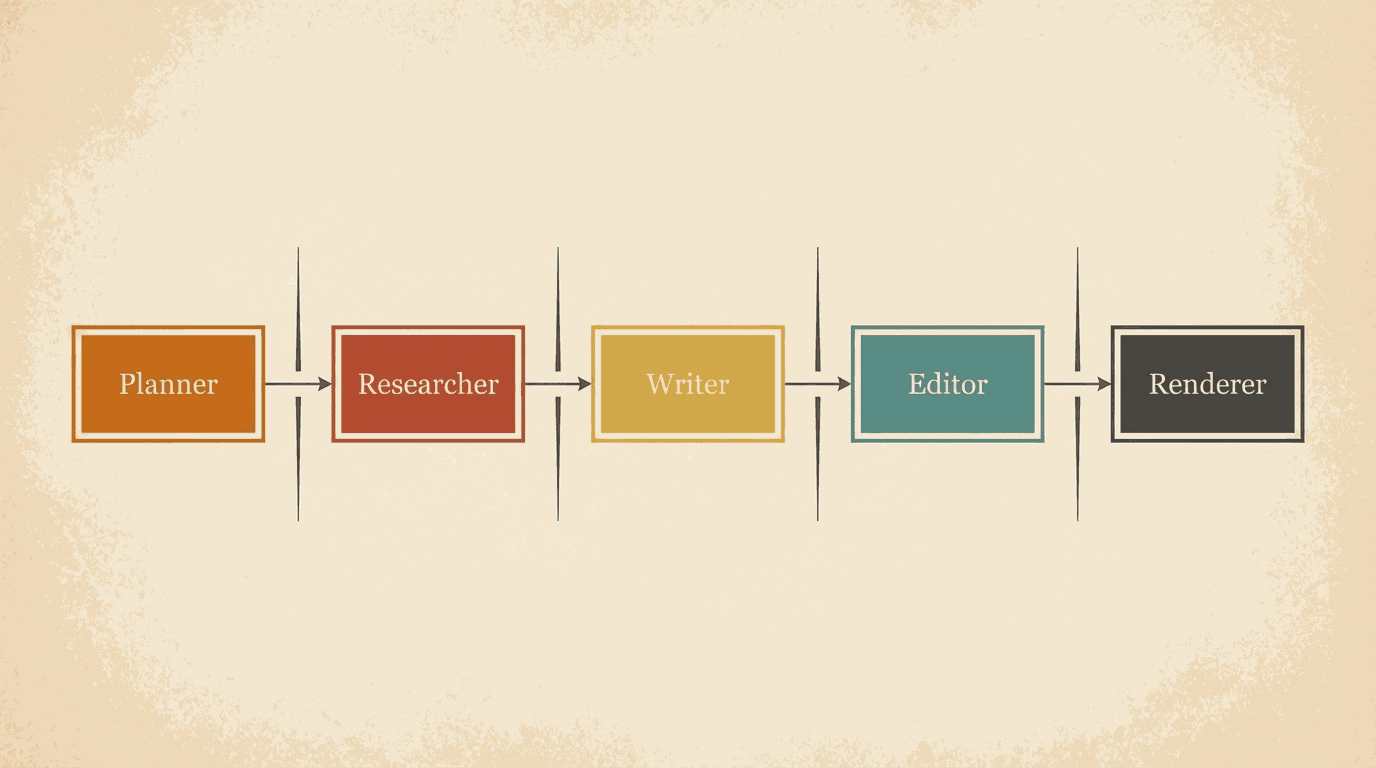
A production workflow needs roles with clear edges:
- a planner that decomposes the task
- a researcher that gathers evidence
- a writer that turns evidence into draft output
- an editor that checks structure, consistency, and voice
- a formatter or renderer that packages the result for the destination surface
This does two important things. First, it reduces prompt sprawl. Second, it makes failures diagnosable. If the result is weak, you can inspect the stage that failed instead of blaming the entire system.
Handoffs need structure
Agent-to-agent communication should not be free-form when a structured payload will do. The more ambiguity you allow in a handoff, the more every downstream agent has to re-interpret intent.
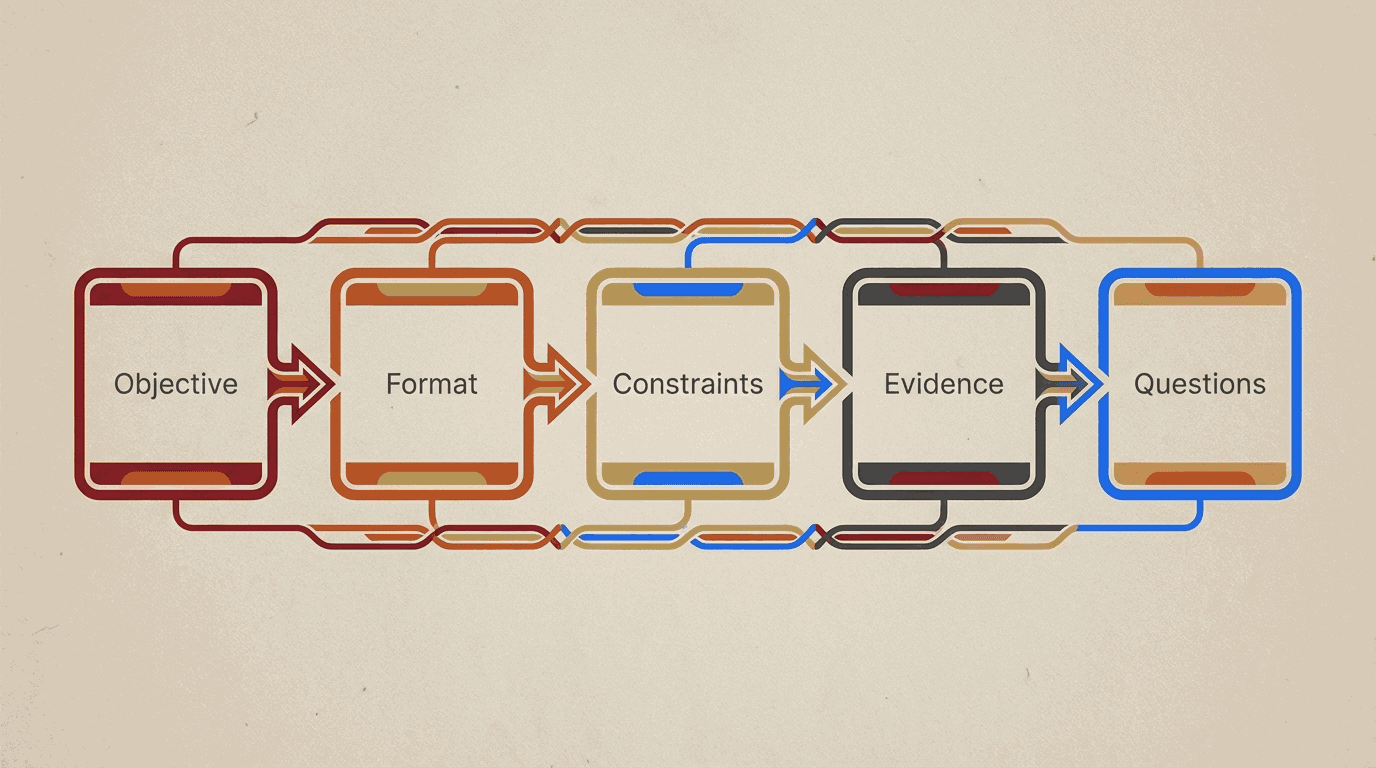
A good handoff usually contains:
- task objective
- required output format
- constraints
- source evidence or references
- unresolved questions
That lets the receiving agent act on a bounded contract. The system becomes easier to reason about because every stage knows what it should consume and what it must produce.
Context isolation is not optional
One of the main reasons multi-agent systems degrade over time is context pollution. If every agent sees every message, the system behaves like one giant, messy prompt with extra ceremony layered on top.
Context isolation fixes that. Each agent should see only what it needs:
- the planner sees the full user goal
- the researcher sees the research question and prior outputs it depends on
- the editor sees the draft plus the editorial checklist
- the renderer sees the final content and layout constraints
This is not just a token-saving trick. It is a correctness improvement. Narrower context reduces accidental role drift and makes outputs more consistent.
Add a supervisor, but keep it thin
A supervisor layer is useful when it coordinates work and resolves failures. It becomes harmful when it tries to do the job of every specialist.
The supervisor should be responsible for:
- spawning the right specialist
- validating required outputs exist
- retrying or rerouting when a step fails
- maintaining the task state
It should not continuously rewrite specialist work unless the workflow explicitly calls for it. Once the supervisor becomes a second writer, second editor, and second researcher, the architecture loses its clarity.
Reliability beats novelty
The best multi-agent architecture is not the one with the most agents. It is the one that produces the same quality level repeatedly under normal load.
That means prioritizing boring but necessary concerns:
- deterministic handoff schemas
- bounded retries
- timeout handling
- observable execution traces
- artifact persistence between steps
These are the details that separate a toy from a system people can operate.
Multi-agent is worthwhile when decomposition is real
If a task is small and linear, one strong agent is usually enough. Multi-agent pays off when the task naturally decomposes into different kinds of work with different context needs. Research, drafting, reviewing, and rendering fit that pattern well.
The mistake is forcing multi-agent structure onto work that does not justify it. The right question is not "How many agents can we add?" It is "Which responsibilities deserve their own boundary because that boundary improves reliability?"
Once you answer that honestly, the architecture gets much simpler. And simple systems are the ones that survive.